
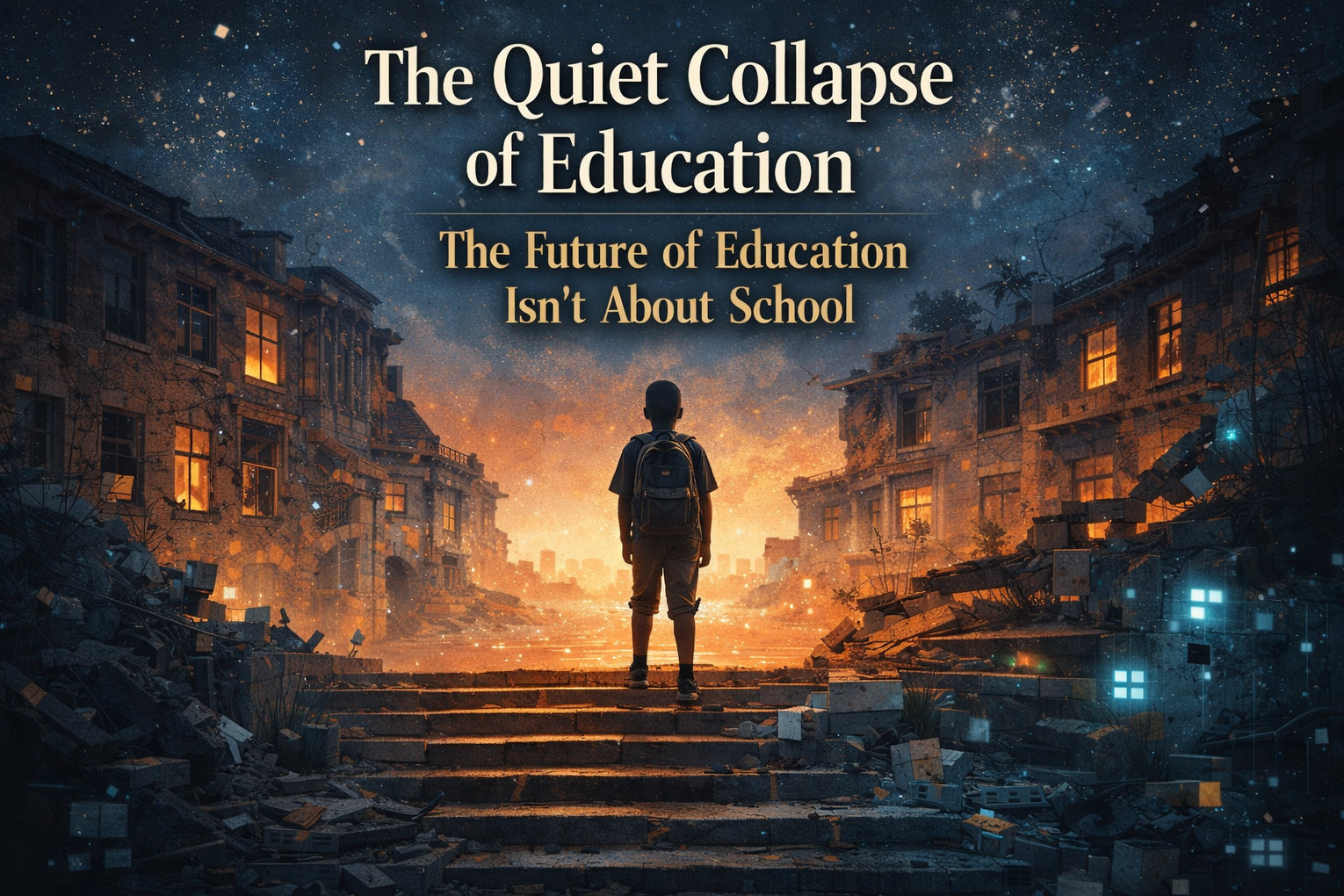
This is Part 1 of the The Quiet Collapse of Education series, a longform exploration of AI, school, identity, and what childhood is becoming in an algorithm world.
I spend a lot of money on my kids’ school.
They’re 14 and 12.
And if I’m being honest, they don’t need it to learn.
They could learn math on YouTube.
They could learn languages on an app.
They could learn history, science, coding, and philosophy from an AI tutor that never gets tired, never loses patience, and never teaches at the wrong pace.
So the uncomfortable question becomes:
What am I actually paying for?
Because the truth is, education quietly changed while we weren’t looking.
Not loudly.
Not through policy.
Not through reform.
It just shifted.
Knowledge Is No Longer Scarce
Schools were built for a world where information was rare.
Books were expensive.
Teachers were the interface.
Classrooms were the only place knowledge lived.
That world is gone.
Today, a motivated kid with a phone can access:
- better explanations than most teachers
- more practice than any classroom
- more perspectives than any textbook
- more feedback than any grading system
AI didn’t start this shift.
It just finished it.
We no longer send kids to school because that’s where learning lives.
Learning lives everywhere now.
School Quietly Became Something Else
And yet, we still send them.
Not because it’s the most effective way to learn.
But because school turned into something deeper.
A human development system.
A place to:
- be seen
- be rejected
- be chosen
- be ignored
- be challenged
- be embarrassed
- be confident
- be awkward
- be resilient
School became a social environment disguised as an academic one.
We don’t say that out loud.
But we all feel it.
The Real Product of School
If school disappeared tomorrow, kids wouldn’t lose access to knowledge.
They’d lose access to:
- peer hierarchy
- social identity
- emotional reps
- leadership moments
- public failure
- real world friction
They’d lose the messy, inefficient, uncomfortable experiences that turn humans into adults.
AI can teach you calculus.
It cannot teach you:
- how to walk into a room
- how to handle rejection
- how to negotiate status
- how to build confidence
- how to belong without disappearing
Those are learned through other humans.
The Human Scene We Can’t Simulate
I’ve watched my son come home quiet after being left out of a group project.
No app teaches you what that feels like.
No algorithm prepares you for being invisible in a room.
But that moment teaches you something real.
How you respond to rejection.
How you interpret silence.
How you decide who you are when nobody is choosing you.
That lesson didn’t come from a screen.
It came from friction.
The Lie We Keep Telling Ourselves
We still talk about school like it’s about learning.
It’s not.
Not anymore.
It’s about environment.
It’s about who your kids become when you’re not in the room.
It’s about:
- what behavior is normalized
- what ambition looks like
- what discipline feels like
- what confidence sounds like
- what failure teaches
We don’t pay for math.
We pay for identity formation.
We just haven’t updated the language yet.
The Dangerous Fantasy of Learn at Home
On paper, the logic is flawless.
Why go to school when AI can teach everything better?
But humans aren’t spreadsheets.
A world of:
- hyper educated
- socially isolated
- emotionally underdeveloped
- algorithm raised kids
is not progress.
It’s fragility in a smarter costume.
Efficiency without development doesn’t create strength.
It creates people who know a lot but can’t navigate life.
What Education Actually Is Now
Education is no longer a place.
It’s a system.
Three layers:
- AI handles cognition.
Knowledge, skills, personalization, acceleration - Humans handle development.
Identity, emotion, hierarchy, conflict, confidence - Parents handle values.
Meaning, direction, boundaries, worldview
School used to own all three.
Now it really only owns one.
And it might be the most important one.
The Quiet Collapse
This didn’t happen with protests or revolutions.
It happened silently.
We kept the buildings.
We kept the schedules.
We kept the report cards.
But the function changed.
School stopped being a learning engine.
And became a social training ground.
We just didn’t rename it.
The Father’s Truth
I don’t send my kids to school because they need help learning.
I send them because I can’t simulate:
- 25 personalities in a room
- real competition
- real rejection
- real leadership
- real consequences
I can teach values.
AI can teach knowledge.
But only humans can teach you who you are in the world.
The Line That Matters
The future of education isn’t about school.
It’s about designing environments that produce strong humans in an algorithm world.
Not smarter kids.
Not better grades.
But people who can:
- think clearly
- relate deeply
- stand confidently
- adapt socially
- and build their own path
In a world where knowledge is free, identity is the only education left.
Up Next
Part 2: Knowledge Is Free
Why information scarcity ended, and why schools were never rebuilt for the new reality.