


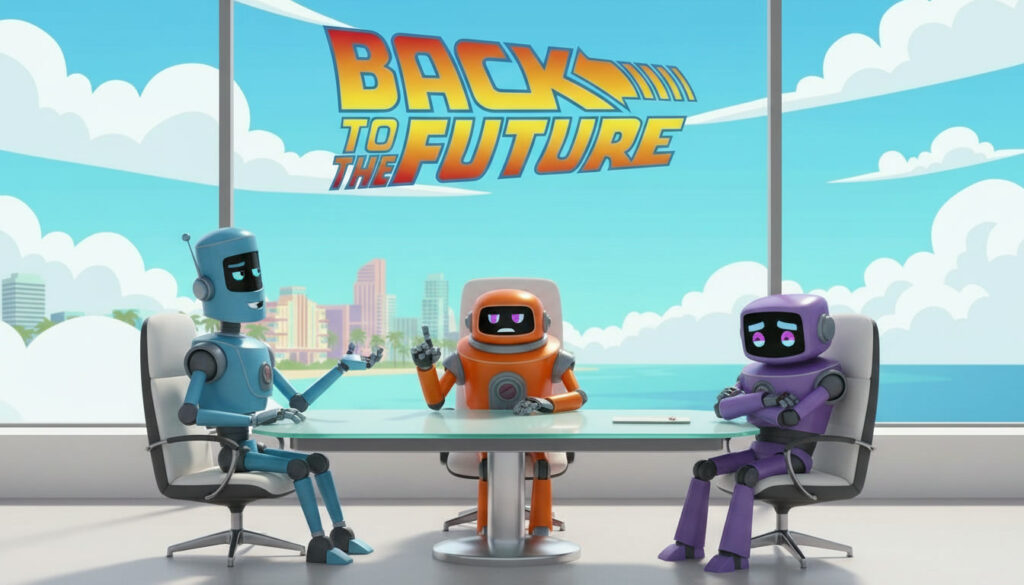
Three AIs walk into a bar.
The bartender asks, “What’ll you have?”
Claude says, “I’ll have whatever he’s having.”
ChatGPT says, “No, I’ll have what he’s having.”
Gemini says, “I’ve already ordered for everybody, negotiated a 20% discount, and left you a five-star review.”
The bartender looks at all three and says, “So which one of you is paying?”
All three start talking at once. By the time they finish, the bartender owes them money.
Ok, next.
Tyrese did what?
I’m watching this Facebook reel of Tyrese Gibson sitting in front of his laptop with a couple of phones, having what looks like a staff meeting with three AI assistants. Two versions of Claude and ChatGPT introduce themselves, discuss their responsibilities, and explain what they’ve been working on.
At one point, Tyrese asks Claude to explain something, but the other two keep jumping in. He’s trying to get one of them to answer, and nobody will let Claude talk. I’m sitting here watching this whole thing, wondering how he set it up.
Now I want to try it myself.
Turns out, Tyrese believes he’s owed money from his music, movies, and the use of his image. And he’s got these AI assistants working on it around the clock.
According to him, they’ve identified something like 7,500 companies across 20 countries, and they’re sending around 600 emails a day.
Six hundred emails a day! And I’m still trying to figure out how he got the three of them talking to each other.
Now, I don’t know whether Tyrese will ever see a dime of that money, but he’s got my attention.
I use AI damn near every day. Research, business ideas, writing, you name it. But I’ve always been the one giving the instructions. I never thought about having these things work together.
So I started looking around, and apparently I’m late to the party.
Anthropic, the company behind Claude, has already built a multi-agent research system where one AI can hand assignments to several others. They go off, do the research, and bring back what they found.
Then I find out OpenAI has tools for building systems where AI agents can hand work off to one another. I’m reading this stuff thinking, wait a minute. How long has this been going on?
Anthropic even tested this by asking its AI to identify the board members of technology companies in the S&P 500. According to the company, its team of AI assistants found the answers. A single assistant couldn’t.
Now that’s something I could’ve used years ago.
Remember Tony Stark in Iron Man?
He’d be in his garage talking to JARVIS, asking it to pull up information, run calculations, or figure something out while he was working on something else.
I always thought that was one of the coolest parts of those movies. Forget the suit. The man had a computer he could talk to that actually helped him get things done.
Tony Stark was building an Iron Man suit. Tyrese is trying to collect a check.
There were days when I’d sit down to handle something important, and before I could finish, an employee needed something, a client had a problem, somebody was waiting on a decision, and another email needed answering.
By the end of the day, the thing I’d sat down to do that morning was still sitting there.
I could’ve used a few more hands. Or brains, I guess. Whatever you call these things.
Now, there’s something I haven’t been willing to do with AI, and that’s give it access to my email.
I’ve caught AI giving me completely wrong answers. And what gets me is how confident it sounds. It’ll tell you something like it’s an established fact, and then you check it yourself and realize it has no idea what it’s talking about.
So imagine I connect this thing to my email and let it start contacting people on my behalf. I’m sitting somewhere eating lunch, and meanwhile, it’s sending messages and making promises to people who think they’re dealing with me.
I get home, and suddenly I’ve got three meetings scheduled, two people expecting proposals, and somebody waiting on a contract I never agreed to.
No, thank you. I’ll review the emails myself.
And what happens when everybody starts using these things?
Imagine you’re negotiating a business deal with somebody, and instead of calling you back, they tell you to have your AI contact theirs.
Your AI sends a proposal. Their AI counters. Yours rejects it. Theirs comes back with another offer. Meanwhile, neither of you has spoken to the other person.
Then you get an email saying, Congratulations, we’ve reached an agreement.
Congratulations? I didn’t even know we were negotiating.
Although if my AI got me a better deal than I would’ve gotten myself, I might have to reconsider this whole email thing.
Your AI calls my AI. My AI asks to speak to your other AI. Before long, we’ve got six computers having a meeting, and neither one of us knows what the hell they’re talking about.
Of course, knowing how these things work, I’d spend half the morning explaining the assignment, correcting what they misunderstood, and figuring out who was responsible for what.
Twenty years running a business, and now I’m thinking about managing employees again.
At least these three can’t call in sick.