


HIDDEN WEALTH
At this point, I might as well stop telling you what’s coming in the next article.
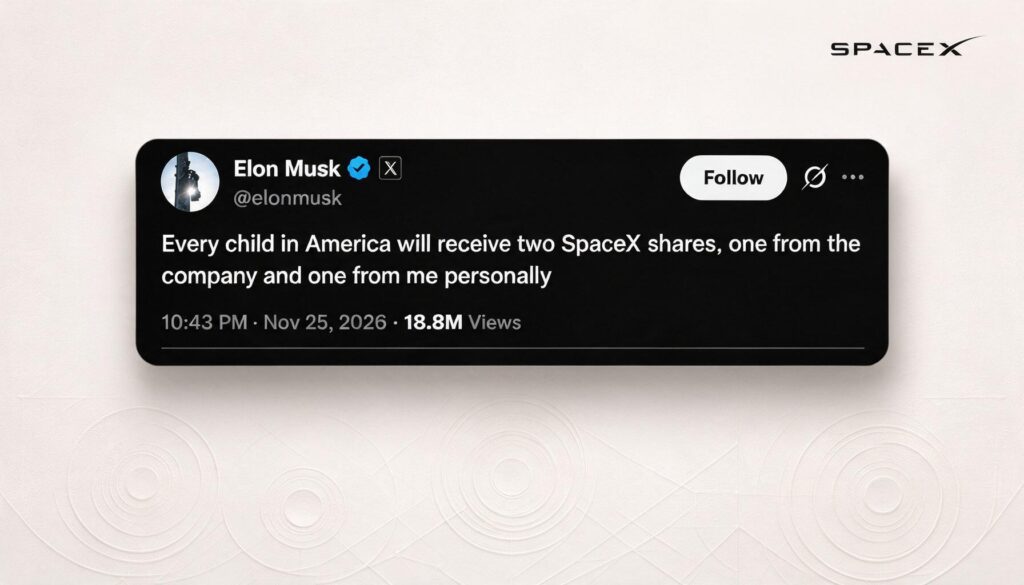
For the second time, I was supposed to be writing about multi-family offices. Then SpaceX announced that it was giving shares of its company to children through Trump Accounts, and there I was, off researching something else.
Having two kids, my initial interest was pretty straightforward. Are my kids eligible? How do I get them signed up? What happens to those shares over the next ten or twenty years?
According to SpaceX’s November 25 announcement, the company committed to contributing one newly issued share of its stock to every currently active Trump Account, with Elon Musk personally matching the company’s contribution. SpaceX President and COO Gwynne Shotwell also announced a separate personal gift of more than two million shares.
Approvals and details still need to be worked out, but think about what SpaceX is proposing. Rather than funding an organization that would develop programs for children, the company wants to give children a piece of the company itself.
Now think about how much money we spend every year trying to help people. Governments, wealthy families, corporations, foundations, and charitable organizations all spend money trying to improve somebody else’s circumstances.
What if we just gave people the money?
Where Does All That Money Go?
Somebody asks you to donate $100 to help feed children. You pull out your phone, enter your credit card information, and a few seconds later, you receive an email thanking you for your donation.
You go about your day. Somewhere, you assume, a child will eat because of something you did.
But what actually happens to that $100 after you hit submit? Who receives it? Who decides how it’s spent? And how many people are involved before a child gets something to eat?
According to Giving USA’s 2026 Annual Report on Philanthropy, Americans donated an estimated $617.2 billion to charitable organizations in 2025. Individuals accounted for $394.2 billion, while foundations contributed another $117.15 billion.
We’re talking about more than half a trillion dollars in a single year. And that’s just charitable giving in the United States.
Some of that money goes to universities, hospitals, churches, museums, research institutions, and organizations providing services throughout the country. Some supports humanitarian efforts worldwide.
Behind those donations are wealthy families deciding which causes to support, foundations managing billions of dollars in assets, investment professionals managing those assets, and organizations competing for funding.
What the Heck Is an NGO?
Whenever there’s a hurricane, an earthquake, or some humanitarian crisis halfway around the world, you’ll hear about NGOs arriving to help.
I knew NGO stood for non-governmental organization, but I always found the name a little confusing. An organization can be independent of the government and still receive millions of dollars in government funding.
It might also receive money from corporations, wealthy families, charitable foundations, or somebody sitting at home donating $25 on their phone. Some of these organizations operate out of a small office in a local community. Others have employees and offices worldwide.
Imagine a wealthy family wants to improve access to education in several developing countries. They might establish a foundation, hire people to manage it, and identify organizations already working in those communities. Those organizations might receive grants to build schools, train teachers, purchase supplies, or administer educational programs.
The family providing the money may never meet the children attending those schools. The children may never know who funded their education. Several organizations sit in between, each responsible for a different part of the process.
And I understand why those organizations exist. If I wanted to build a school in another country, I’d have no idea where to begin. I’d need people who understood the community, the local government, construction, education, and a hundred other things I hadn’t considered.
But what if the school already exists, the teachers are already there, and the only reason a child isn’t attending is that the parents can’t afford it?
The Business of Helping People
I spent nearly twenty years running a home care business. If there’s one thing I understand, it’s the difference between what somebody pays for a service and what it costs to deliver it.
If somebody paid my company for eight hours of home care, most of what they saw was the caregiver who showed up at their house.
What they didn’t see was the person recruiting that caregiver, the person conducting background checks, the scheduler trying to cover a shift at the last minute, the payroll department, the insurance, the software, and the office that somebody had to keep running whether we had a good week or a bad one.
All of that cost money.
Now imagine an elderly woman needs eight hours of home care a day but can’t afford it. Home care agencies in her community have caregivers looking for work. Those businesses are already equipped to provide the service she needs.
Nobody needs to build anything. Nobody needs to develop a new program. The infrastructure already exists. The woman just doesn’t have the money.
What happens if somebody gives her the money to purchase home care?
She calls an agency. The agency schedules a caregiver. The caregiver earns a paycheck. The agency generates revenue and uses some of it to pay employees, buy supplies, pay rent, and cover other business expenses.
The caregiver goes to the grocery store, pays their electric bill, puts gas in their car, and takes care of their own family.
All of that economic activity started with giving one woman the money to purchase something she needed.
Now imagine a foundation wants to spend $10 million helping elderly people remain in their homes. How much of that money could go directly toward allowing those individuals to purchase services from businesses already operating in their communities?
You might need somebody to verify eligibility, protect vulnerable people from fraud, and make sure they’re receiving appropriate care. But do you necessarily need an entirely new organization delivering the service?
And if you do, what is that organization providing that doesn’t already exist?
I imagine running a large humanitarian organization presents many of the same challenges, except now you’re potentially coordinating employees, contractors, programs, and financial resources across several countries.
There are offices to maintain, employees to pay, technology to purchase, financial reports to prepare, and regulations to follow. Somebody has to identify who needs help, somebody has to deliver it, and somebody has to make sure the money is used appropriately.
Being a nonprofit doesn’t eliminate the expenses associated with running an organization. It also doesn’t mean that the people working there aren’t earning a living.
If that foundation spends $10 million helping elderly people remain in their homes, how much of it actually pays for somebody to show up at their house? And how many of those people are still living independently when the funding runs out?
Those are two different questions. An organization could spend very little on administrative expenses and still accomplish very little. Another could have substantial operating expenses and produce extraordinary results.
I’d want to know what happened to the families.
What If We Just Gave People the Money?
Imagine somebody’s car breaks down on a Tuesday morning. They have a job, but they don’t have the $500 the mechanic wants to fix the car. They miss work on Wednesday, then Thursday, and now they’re worried about losing the job that would’ve allowed them to pay for the repair in the first place.
Across town, somebody else has been offered a job but can’t afford childcare until they receive their first paycheck.
And somewhere else, somebody knows how to cut grass, has neighbors willing to pay them, but doesn’t have enough money to buy a lawn mower.
All three people qualify for a program providing $500 worth of groceries to families experiencing financial hardship.
They all need groceries. But if you asked each of them what would make the biggest difference in their lives that week, I suspect you’d get three different answers.
Of course, somebody could make a terrible decision with the money. That’s possible. People make terrible financial decisions at every income level.
The person with the broken car might still need help buying groceries next month. Fixing the car, however, could be the difference between having a job next month and not having one.
There’s a difference between helping somebody get through the week and giving them the resources to change what happens the following week.
Apparently, there’s an organization built around letting people make those decisions for themselves.
Wait, There’s an Organization That Actually Does This?
It’s called GiveDirectly. And here’s the irony. It’s an NGO.
The organization provides cash transfers to people experiencing poverty, often without requiring them to spend the money on anything specific.
Instead of identifying a family’s needs and purchasing something on their behalf, the organization identifies eligible households and gives them money. The households decide what to do with it.
In 2016, economists Johannes Haushofer and Jeremy Shapiro published a randomized study in The Quarterly Journal of Economics examining unconditional cash transfers distributed by GiveDirectly in rural Kenya.
Households receiving the money increased their spending, and researchers found improvements in psychological well-being. Households receiving monthly payments experienced greater improvements in food security than those receiving lump sums, while lump-sum recipients were more inclined to purchase lasting goods.
Then I came across another study published in Econometrica in 2022.
This one examined approximately $1,000 in cash transfers provided to more than 10,500 households across 653 villages in rural Kenya.
The researchers found that the benefits extended beyond the households receiving the money. Local businesses and households that hadn’t received transfers benefited from the additional economic activity, while increases in local prices were relatively small.
Remember that elderly woman who needed home care?
The money she spends doesn’t disappear when she pays the agency. It becomes somebody’s paycheck, somebody’s grocery money, and revenue for other businesses in the community.
Something similar happened in the Kenyan villages. Even some of the people who didn’t receive money benefited because their neighbors suddenly had money to spend.
You didn’t necessarily have to give the local business owner money. You could give their customers money.
That doesn’t mean the results from rural Kenya would be identical everywhere, or that giving people money will solve every problem associated with poverty. But it does give us something more substantial than a hypothetical conversation about what people might do if we trusted them with the money.
Giving Somebody Money vs. Giving Somebody Ownership
Which brings me back to SpaceX.
Giving somebody $1,000 to spend is one thing. Giving them $1,000 worth of something they can own for the next 50 years is something entirely different.
Under the Trump Account program, eligible American children born between 2025 and 2028 can receive a $1,000 federal contribution to an investment account. Older eligible children can also establish accounts, although they don’t qualify for that particular federal contribution.
The accounts are subject to investment and withdrawal restrictions, particularly before adulthood. SpaceX’s proposed stock contribution is a separate commitment, and its implementation is still subject to approval.
Imagine a child receiving $1,000 at birth. Assuming a hypothetical annual return of 7%, with no additional contributions, that investment could be worth approximately $3,380 by age 18. If it remained invested until age 65 under the same assumptions, it could grow to more than $81,000 before taxes, fees, and inflation.
There’s no guarantee of those returns, but imagine sitting down with your 12-year-old and showing them an investment account that’s theirs.
Last month it was worth $1,200. This month it’s worth $1,100. Now they’re asking you where the other $100 went.
That’s a completely different conversation from telling your child they need to learn about investing. They’ve got money involved now. They have a reason to pay attention.
We’ve spent several articles talking about the advantages children in wealthy families have because they’re exposed to conversations about money, investments, and ownership growing up.
What if more children had something of their own that gave them a reason to have those conversations?
Does Every Problem Need an Organization?
I don’t think giving people money is the answer to everything.
If a community doesn’t have access to clean drinking water, giving every household $500 doesn’t necessarily create a water system. If there isn’t a hospital within a hundred miles, depositing money into somebody’s bank account doesn’t bring a hospital any closer.
If there aren’t qualified caregivers in a community, giving an elderly woman money to buy home care won’t do much for her. Somebody needs to recruit caregivers, train them, and establish the infrastructure to deliver those services.
But if there are five home care agencies within ten miles of her house, all looking for new clients, and she simply can’t afford to hire one, that’s a completely different situation.
In one case, you need to create something. In the other, you need to give somebody access to something that already exists.
I don’t know how much charitable funding goes toward solving the first problem versus the second. But if I were responsible for distributing millions of dollars, I’d want to know the difference before I spent a dime.
What Would You Do With $100 Million?
Imagine you’ve accumulated enough wealth to give away $100 million.
You could establish a foundation, hire a team, and create programs designed to improve people’s lives. You could support universities, hospitals, research institutions, or existing humanitarian organizations.
You could also take that same $100 million and, before distribution costs, give $10,000 to each of 10,000 families.
Or you could put $1,000 into investment accounts for 100,000 children.
Three very different approaches to helping people, using the same amount of money.
And in the second scenario, you’ve suddenly got 10,000 families with purchasing power they didn’t have before.
Some of that money might go to mechanics, childcare providers, landlords, dentists, contractors, or local grocery stores. Some might be used to start businesses. Some might be saved.
Think about what that means for a small business owner. You didn’t give them a grant. You didn’t create a program to help their business. You gave the people in their community the money to become their customers.
Now fast-forward twenty years.
How many people received services they otherwise wouldn’t have received? How many families were able to purchase homes, start businesses, or get themselves out of difficult financial situations? How many children entered adulthood with investments they could continue building throughout their lives?
And what happened to the communities surrounding those families?
I suspect the best use of the money might involve some combination of all three approaches. But I’d want to see the results rather than assume one approach works better simply because that’s the way we’ve always done it.
Somewhere, a wealthy family could be sitting around a conference table trying to decide what to do with $100 million. They have the resources to make these decisions, and there’s an entire profession dedicated to helping them figure out how to give their money away.
Philanthropic advisors, foundation executives, investment managers, attorneys, and researchers spend their careers working on questions most of us rarely consider.
Who Gets to Decide?
When I think about my own children, I want to give them the knowledge and resources to make good decisions as they get older. I don’t expect to spend the rest of my life deciding everything for them.
At some point, they have to take what they’ve learned and whatever resources they’re fortunate enough to have and figure out what to do with them.
Imagine somebody giving you $10,000 to improve your life, but before you can receive it, a group of people you’ve never met gets together to decide what you need.
They may be well educated, experienced, and genuinely interested in helping you. But they don’t know what happened to your car last Tuesday, what your employer told you yesterday, or what opportunity you might have to turn that $10,000 into something more.
Sometimes the person who needs the money might also be the person who knows exactly what to do with it.
I began this article trying to figure out whether my kids could receive shares of SpaceX. Somehow, I ended up exploring an industry that distributes hundreds of billions of dollars every year.
And I still have that other question about wealthy families who need somebody coordinating their investments, taxes, estate planning, business interests, and now, apparently, their charitable giving.
I think we’ve established that there’s an entire business for that.
I’m just not going to tell you what I’m writing about next.