
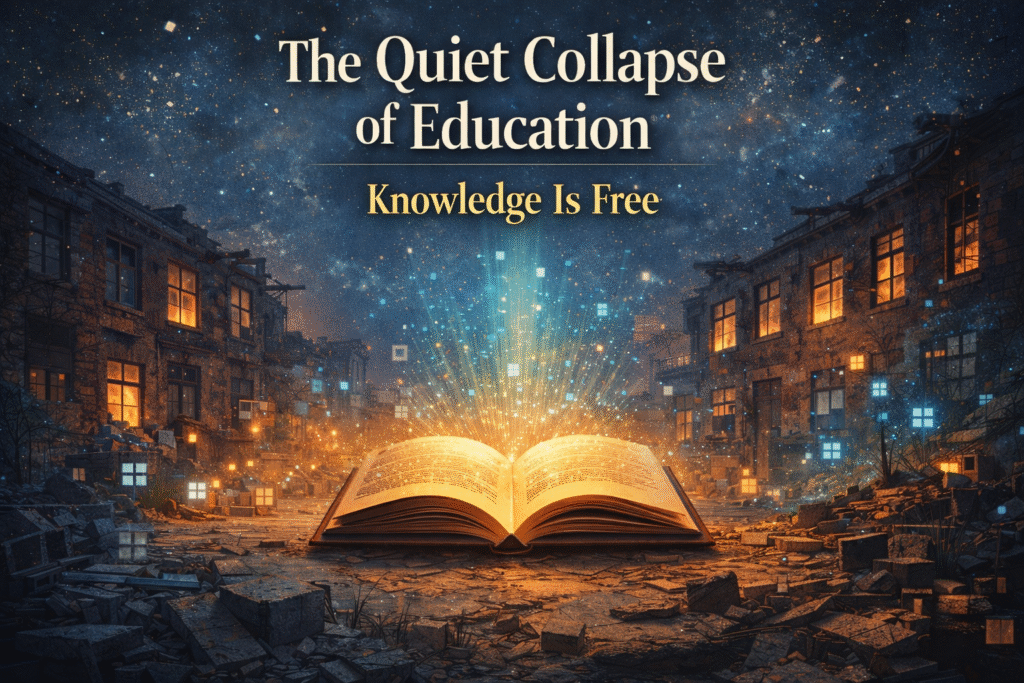
his is Part 2 of the The Quiet Collapse of Education series, a longform exploration of AI, school, identity, and what childhood is becoming in an algorithm world.
There was a time when knowledge had a gate.
You had to:
- go to a building
- sit in a room
- listen to one person
- at one speed
- with one explanation
That person was the interface to information.
We called them a teacher.
That system made sense in a world where:
- books were scarce
- libraries were limited
- experts were unreachable
- and information moved slowly
School was not just helpful.
It was necessary.
That world is gone.
The End of Information Scarcity
Today, a motivated kid with a phone has access to:
- every subject
- every level
- every explanation style
- every language
- every practice problem
- every perspective
For free.
Not in theory. In reality.
If a student does not understand something today, it is no longer because the knowledge is unavailable.
It is because:
- they are distracted
- unmotivated
- or unsupported
Not because the information does not exist.
The bottleneck is no longer access.
It is attention.
The Quiet Shift Nobody Announced
We still talk about education like it is about delivering information.
But information delivery is already solved.
Quietly.
Through:
- YouTube
- Khan Academy
- Duolingo
- Coursera
- ChatGPT
- tutoring platforms
- open universities
- online communities
Most people do not realize how radical this is.
We replaced a system that took centuries to build in about twenty years.
And then kept pretending nothing changed.
The Classroom Is Now the Slowest Interface
This is the uncomfortable part.
A single teacher:
- teaching 25 kids
- at one pace
- with one explanation
- on one schedule
is now one of the least efficient ways to transfer knowledge.
Not because teachers are bad.
But because the model is outdated.
AI does not get tired.
It does not lose patience.
It does not repeat itself differently each time.
It does not move too fast or too slow.
It adjusts to the student.
The classroom adjusts the student to the system.
Those are opposite designs.
The Human Scene We Keep Ignoring
I have watched kids spend six hours in school struggling with a concept they could have understood in twenty minutes online.
Then go home and spend three more hours scrolling without learning anything at all.
Same child.
Same day.
Same brain.
One environment moved too slow.
The other offered infinite stimulation.
Neither taught them how to choose.
We Confuse Access With Motivation
One of the biggest lies in education is:
“If knowledge is free, everyone will learn.”
That is not true.
What changed is not that everyone learns.
What changed is that nobody is blocked from learning anymore.
Which means success now depends on:
- discipline
- curiosity
- emotional stability
- self direction
Not on school quality.
Two kids in the same classroom can now have completely different educations outside of it.
One goes home and scrolls.
The other goes home and builds.
They are technically in the same system.
But functionally in different worlds.
The Real Function of School Is Already Shifting
Schools still act like they control knowledge.
They do not.
Students already learn:
- faster online
- deeper through communities
- more practically through content
- more personally through AI
School is no longer the source.
It is just one environment among many.
And often not the best one.
The Invisible Redefinition of Education
We are living through a redefinition without the language for it.
Education used to mean:
“Where do you get information?”
Now it means:
“How do you direct yourself in a world of infinite information?”
That is a completely different skill.
And schools were never built to teach it.
The New Divide Nobody Talks About
The old divide was:
- rich schools vs poor schools
- good teachers vs bad teachers
- urban vs suburban
The new divide is:
- self-directed vs dependent
- curious vs distracted
- emotionally stable vs overwhelmed
- builders vs consumers
Knowledge is available to everyone.
But attention is not.
And neither is discipline.
The Quiet Collapse
Schools did not fail.
They were outgrown.
They were designed for scarcity and woke up in abundance.
They still teach content.
But the world now teaches faster.
More adaptively.
More personally.
More constantly.
The monopoly is gone.
The buildings remain.
The Line That Matters
Knowledge is no longer the product of education.
It is the raw material.
The real skill now is not learning.
It is choosing what to learn, when to learn, and why.
And that is something no curriculum ever taught.
Up Next
Part 3: School Is a Social System, Not a Learning System
Why school’s real function shifted from teaching information to shaping identity, hierarchy, and human behavior.