


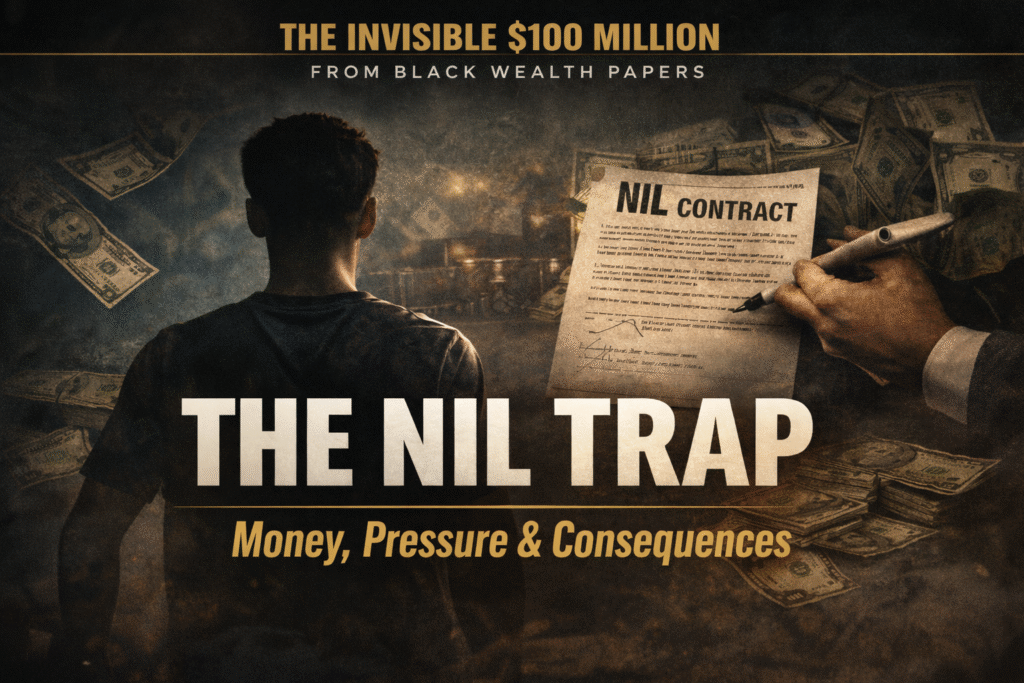
Part 3 of The Invisible $100 Million Series
From The Black Wealth Papers
When NIL was introduced, the culture celebrated.
Finally, athletes would get paid.
Finally, the system would be fair.
Finally, the exploitation would end.
That celebration skipped an important question.
Paid for what.
Paid how.
Paid with what protection.
Because while NIL changed who could earn, it did not change who controlled the system.
What NIL Promised
NIL was sold as freedom.
Freedom to monetize talent.
Freedom to build a brand.
Freedom to earn before the pros.
And on the surface, it delivered.
Teenagers signing six-figure deals.
College athletes driving luxury cars.
Social media profiles turning into revenue streams overnight.
The visibility was real.
The money was real.
The preparation was missing.
Who NIL Really Benefits
NIL did not arrive in a vacuum.
It arrived inside a system already built around:
agents
marketers
brand managers
platforms
networks
and intermediaries
Everyone knew how to make money from athletes.
Almost no one knew how to teach athletes how to keep it.
Teenagers were suddenly negotiating contracts with adults who had spent decades inside business systems.
That imbalance matters.
Adult Traps, Child Timelines
A fifteen or eighteen-year-old athlete is not failing when they make adult mistakes.
They are being asked to operate inside adult financial systems without adult experience.
Contracts arrive fast.
Attention arrives faster.
Pressure arrives instantly.
And the same habits built in the youth pipeline follow them here.
Someone else manages the details.
Someone else explains the terms.
Someone else reassures them that everything is handled.
They learn trust.
Not understanding.
Why “It’s Better Than Nothing” Misses the Point
Some argue NIL is still progress.
Better than universities getting everything.
Better than unpaid labor.
That may be true.
But progress without protection is not freedom.
It is exposure.
If adults with full support systems still struggle to navigate wealth,
what chance does a teenager have with none of the preparation?
NIL did not remove the traps.
It accelerated access to them.
Visibility Is Not Value
NIL taught athletes a dangerous lesson early.
Attention equals worth.
Followers equal leverage.
Money equals success.
But visibility is not ownership.
Income is not security.
A brand can disappear overnight.
An algorithm can change.
A contract can end.
Without systems underneath, the money moves faster than the understanding.
The Setup No One Wants to Admit
NIL did not break the cycle.
It simply moved the starting line closer to childhood.
The same financial pressure.
The same lack of literacy.
The same extraction.
Just earlier.
Athletes are now learning the hardest lessons about money before they are legally allowed to drink.
That is not empowerment.
That is acceleration without a seatbelt.
The Bigger Warning
NIL is not the villain.
The absence of structure is.
Without education, trusts, long-term planning, and real ownership pathways, NIL becomes the first collision with a system athletes were never prepared to navigate.
And once that collision happens early, it shapes every financial decision that follows.
This is why the money feels fast.
This is why it feels unstable.
This is why the curve repeats.
Not because athletes are careless.
Because the system taught them how to earn before it ever taught them how to build.
About the Author
Brian B. Turner is the author of The Black Wealth Papers, a cultural and financial book series examining how wealth, timing, systems, and history shape outcomes long before individual decisions are made.
His work focuses on first-generation earners, athletes, entrepreneurs, and builders navigating systems they were never taught to understand. Rather than blaming individuals, his writing exposes the structures behind money, ownership, and power, and offers clarity where shame is usually placed.
The Invisible $100 Million is the second book in The Black Wealth Papers series and a direct continuation of Why You Are Not Behind.
About the Book
The Invisible $100 Million explores why so many Black athletes and entertainers earn massive sums yet struggle to keep it, not because of recklessness, but because they collide with systems never designed for them to build ownership.
From youth sports pipelines and NIL deals to draft-day contracts, media narratives, and predatory financial ecosystems, the book reveals how wealth can disappear even when the income looks enormous.
This is not a scandal book.
It is a cultural and financial investigation.
📘 The Invisible $100 Million
👉 https://amzn.to/4jjIUKY