
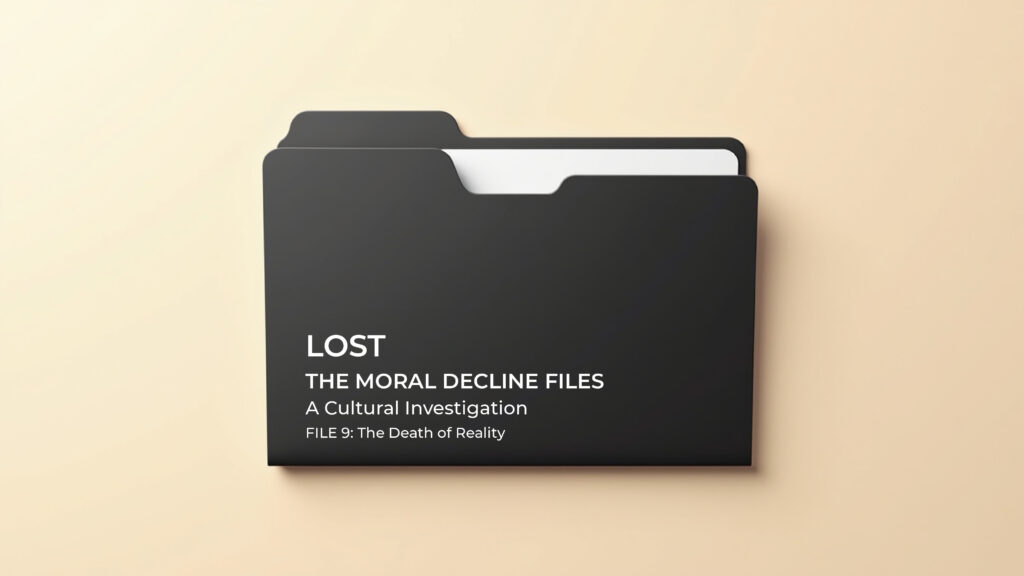
A 13-Part Cultural Investigation
Case Overview
Reality got edited.
Then recommended.
Then replaced.
There was a time when truth felt heavier than opinion.
Not because everyone agreed.
But because facts had weight.
You could argue about what something meant,
but you could not argue about whether it happened.
News was not perfect.
Media was not pure.
But there was a shared understanding that reality existed outside of personal preference.
Somewhere along the way, that common ground cracked.
Not in one moment.
But in a thousand edits, a thousand headlines, a thousand incentives.
Truth did not disappear.
It got rewritten for attention.
Back Then: When Credibility Still Mattered
You remember when news felt like information.
Not identity.
Anchors were boring on purpose.
Articles were longer.
Corrections mattered.
You had a few trusted sources.
You read them.
You moved on.
A mistake was a problem.
A lie was a scandal.
A retraction meant something.
Media did not need to entertain you.
It needed to inform you.
And most people still believed that honesty was the cost of admission.
When the Blur Began
Then the cycle sped up.
The 24-hour news loop demanded constant urgency.
Silence became failure.
Patience became irrelevant.
Headlines got sharper.
Stories got shorter.
Outrage became a reliable fuel.
Media stopped reporting reality
and started competing for attention.
The goal shifted from accuracy to engagement.
From context to impact.
From truth to traction.
Then social media arrived and finished the job.
Everyone became a broadcaster.
Every opinion became a headline.
Every clip became a verdict.
Reality got chopped into moments.
Moments got stripped of context.
And context became optional.
The truth did not lose.
It got tired.
The Gray Area We Live In
Today, information does not just reach you.
It targets you.
Your feed does not show what is true.
It shows what you are most likely to react to.
Outrage spreads faster than nuance.
Fear spreads faster than facts.
Certainty spreads faster than honesty.
We do not live in one reality anymore.
We live in personalized versions of reality, built for retention.
And when reality is personalized, accountability disappears.
People stop asking, “Is it true?”
They ask, “Is it on my side?”
Truth becomes tribal.
Media becomes a weapon.
And confusion becomes the environment.
We call it being informed.
But often it is just being activated.
The Mirror That Finally Turned Back On Us
We blame the media for lying.
We blame social platforms for manipulation.
We blame algorithms for distortion.
But the demand came first.
We wanted faster answers.
We wanted simpler villains.
We wanted stories that confirmed what we already believed.
We rewarded emotion over evidence.
We rewarded certainty over honesty.
We rewarded outrage over understanding.
The media learned our appetite.
Then fed it back to us.
Reality did not collapse from lack of information.
It collapsed from the way we consumed it.
When people stop trusting facts,
they stop trusting each other.
And when trust dies, truth becomes optional.
Before We Move Forward
This file exists to name the shift.
From credibility to content.
From reporting to reaction.
From shared reality to curated belief.
When reality becomes negotiable, discipline becomes difficult.
Work ethic weakens.
Honor fades.
Shortcuts start looking normal.
FILE 10 examines what happened when effort stopped being a virtue
and convenience became king.
File Closed.
About the Author
Brian B. Turner is a writer, creator, and cultural storyteller exploring what America gains, loses, and forgets in the noise. His latest book, LOST: The Collapse of Morals in America, is available now on Amazon: https://amzn.to/49RhxoK.