
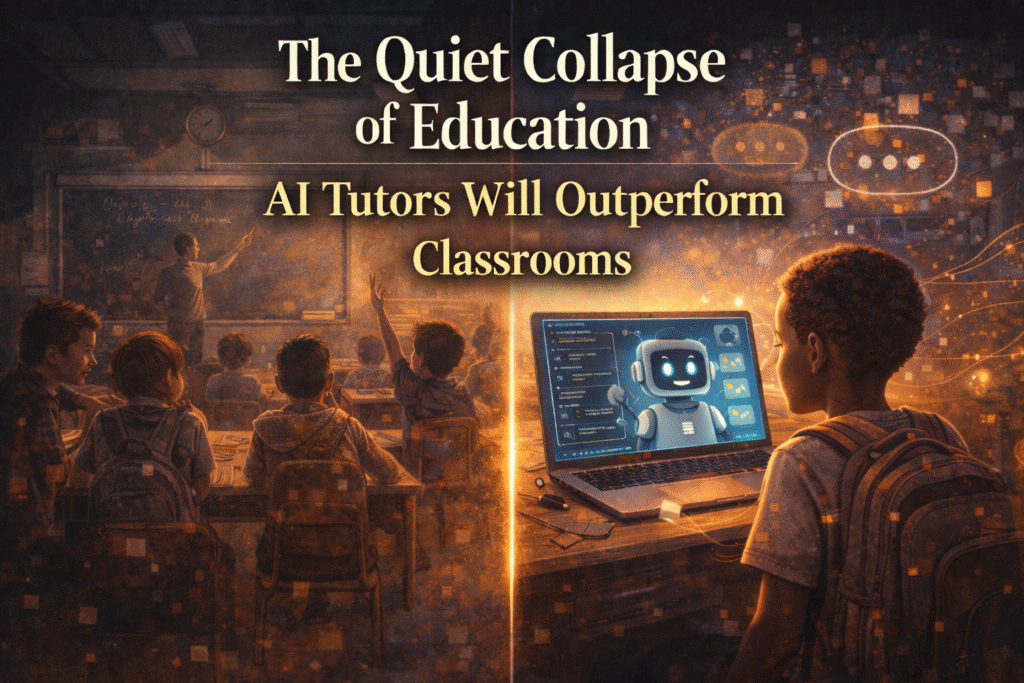
This is Part 4 of the The Quiet Collapse of Education series, a longform exploration of AI, school, identity, and what childhood is becoming in an algorithm world.
This is the part most people resist.
Not because it is false.
But because it threatens something familiar.
The idea that one human in a room can teach twenty-five children better than a personalized machine is already outdated.
We just have not admitted it yet.
The One Size Problem
Classrooms were built around a single constraint.
One teacher.
Many students.
Which means:
- one pace
- one explanation
- one style
- one timeline
Everyone adapts to the system.
Not the other way around.
Some kids are bored.
Some are lost.
Some pretend.
Some fall behind quietly.
This is not a failure of teachers.
It is a failure of design.
How AI Actually Teaches
AI does not teach like a human.
It teaches like a mirror.
It:
- adapts to how you think
- repeats without frustration
- changes explanation style
- slows down or speeds up
- identifies gaps instantly
- never forgets where you struggled
It does not assume the student is average.
It treats every student as unique.
That alone makes it a fundamentally superior learning system.
The Human Scene We Can All Recognize
Every parent has seen this.
A kid stuck on homework for an hour.
Frustrated.
Tired.
Embarrassed to ask for help.
Then they open a video or an app.
And suddenly it clicks in five minutes.
Same material.
Same brain.
Different interface.
One was built for a room.
The other was built for them.
The Feedback Loop That Changes Everything
In school:
- feedback comes days later
- mistakes linger
- confusion compounds
With AI:
- feedback is instant
- errors are corrected immediately
- understanding stacks cleanly
Learning becomes:
- faster
- smoother
- less emotional
- less shame-based
Which matters more than people realize.
Because most kids do not hate learning.
They hate feeling stupid in public.
The Scalability Reality
A great teacher can change dozens of lives.
A great AI system can change millions.
Not with burnout.
Not with turnover.
Not with fatigue.
Just with iteration.
The best explanation in the world can now be:
- copied infinitely
- improved constantly
- personalized endlessly
That is not a threat.
That is progress.
Most great teachers already do this instinctively. AI just does it at scale.
Why This Is Irreversible
This is not a trend.
It is an economic reality.
Systems that are:
- cheaper
- faster
- more personalized
- more available
always win.
Not because they are better morally.
But because they are better structurally.
Education is no exception.
The Emotional Resistance
People do not reject AI tutors because they do not work.
They reject them because they feel impersonal.
But the irony is:
Most classrooms are already impersonal.
Twenty-five kids.
One pace.
Minimal attention.
Limited customization.
That is not human-centered.
That is logistical.
AI is the first system built around the learner, not the institution.
The Quiet Collapse
Schools still exist.
Teachers still teach.
But the cognitive monopoly is over.
Learning has already moved.
Quietly.
Individually.
At home.
On phones.
On laptops.
In private.
Classrooms did not get replaced.
They got bypassed.
The Line That Matters
AI tutors will not replace schools.
They will replace the learning function of schools.
Which means schools will have to finally admit what they already became.
Not learning engines.
But human development environments.
Up Next
Part 5: The Social Cost of Optimization
Why hyper-efficient learning creates emotionally weaker humans if social development is ignored.