


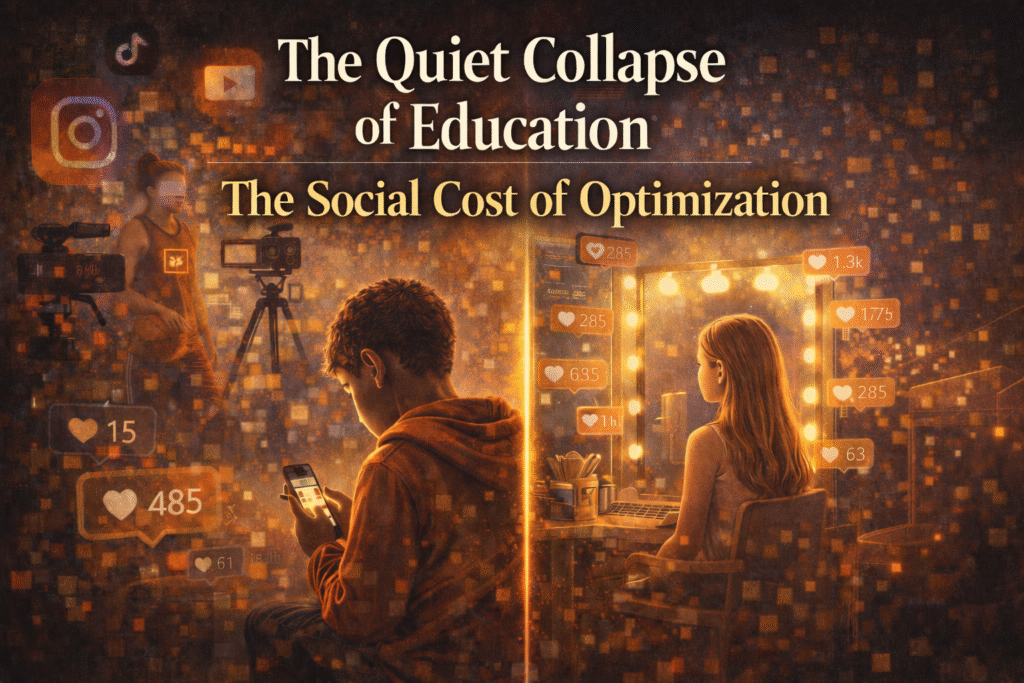
This is Part 5 of the The Quiet Collapse of Education series, a longform exploration of AI, school, identity, and what childhood is becoming in an algorithm world.
Every system that becomes more efficient changes human behavior.
Not just productivity.
Identity.
When you optimize for speed, convenience, and scale, you also shape what people value.
Education is no different.
The Trade We Pretend Does Not Exist
AI makes learning:
- faster
- cheaper
- more personalized
- more accessible
But every gain comes with a trade.
When you remove friction from learning, you also remove:
- social struggle
- emotional resistance
- public failure
- awkward growth
- human tension
Which means you remove the environments that build:
- confidence
- resilience
- emotional intelligence
- identity under pressure
Optimization solves problems.
It also removes experiences.
The Algorithm Child
We are already watching a new type of child emerge.
Kids who grow up:
- learning alone
- performing for metrics
- rewarded by views
- guided by algorithms
- validated by numbers
Not by:
- peers
- mentors
- communities
- real-world feedback
Their identity is shaped by:
- attention
- visibility
- engagement
- performance
Not belonging.
Not contribution.
Not depth.
When Visibility Replaces Competence
This is where the culture shifted.
We used to reward:
- mastery
- skill
- patience
- progression
Now we reward:
- exposure
- personality
- entertainment
- branding
- consistency
A teenager can become famous without learning anything.
A streamer can build wealth without building competence.
An athlete can build a following before building fundamentals.
A student can perform successfully without developing internally.
The system does not care what you know.
It cares how you appear.
The Human Scene We All Recognize
Every kid today knows who the creators are.
They know:
- the YouTubers
- the streamers
- the influencers
- the viral athletes
- the TikTok personalities
These people did not go through traditional education.
Yet they have:
- money
- attention
- status
- cultural power
So the quiet lesson becomes:
Why struggle through slow systems when visibility pays faster?
Not wrong.
Just dangerous.
The New Incentives for Young Athletes
This is especially visible in sports.
Young athletes now learn:
- exposure matters more than fundamentals
- branding matters more than patience
- attention brings opportunities
- performance must be visible
With NIL and social platforms, the message is clear.
You are not just an athlete.
You are a product.
So even kids who want to succeed learn to:
- document themselves
- market themselves
- perform their lives
- shape perception early
Before identity has even formed.
Girls and the Attention Economy
This shows up differently for girls.
The algorithm rewards:
- appearance
- likability
- engagement
- emotional performance
Not quiet competence.
Not slow mastery.
Not private growth.
So the lesson becomes:
Be visible.
Be desirable.
Be entertaining.
Not necessarily:
- be strong
- be skilled
- be grounded
That is not social development.
That is identity shaped by external validation.
What Optimization Does to the Human Mind
When systems reward speed and visibility, humans adapt.
They become:
- anxious without feedback
- uncomfortable with silence
- dependent on metrics
- afraid of being unseen
- disconnected from internal value
The cost is not ignorance.
It is fragility.
Smart kids who:
- cannot tolerate boredom
- cannot navigate rejection
- cannot build slowly
- cannot exist without attention
That is the social cost of optimization.
The Personal Truth
As a parent, this is the part that worries me the most.
Not whether my kids will be smart.
But whether they will know who they are when nobody is watching.
We Replaced One System Without Understanding the New One
We left a flawed system.
School was slow.
Institutional.
Rigid.
But it forced:
- shared experiences
- human friction
- emotional development
- social calibration
The new system is:
- individualized
- efficient
- infinite
- private
But it isolates.
It optimizes.
It removes the human mirror.
The Quiet Collapse
Education became more powerful.
But humans became more alone.
We removed:
- group struggle
- public growth
- shared identity
And replaced it with:
- performance
- metrics
- self branding
- algorithmic validation
The system works.
But the humans are weaker inside it.
The Line That Matters
Optimization makes systems better.
It does not automatically make people stronger.
In a world where learning is private, instant, and frictionless, the real risk is not ignorance.
It is identity without depth.
Up Next
Part 6: What Parents Are Actually Paying For
Why tuition is no longer about education, and what families are really buying in the modern school system.