

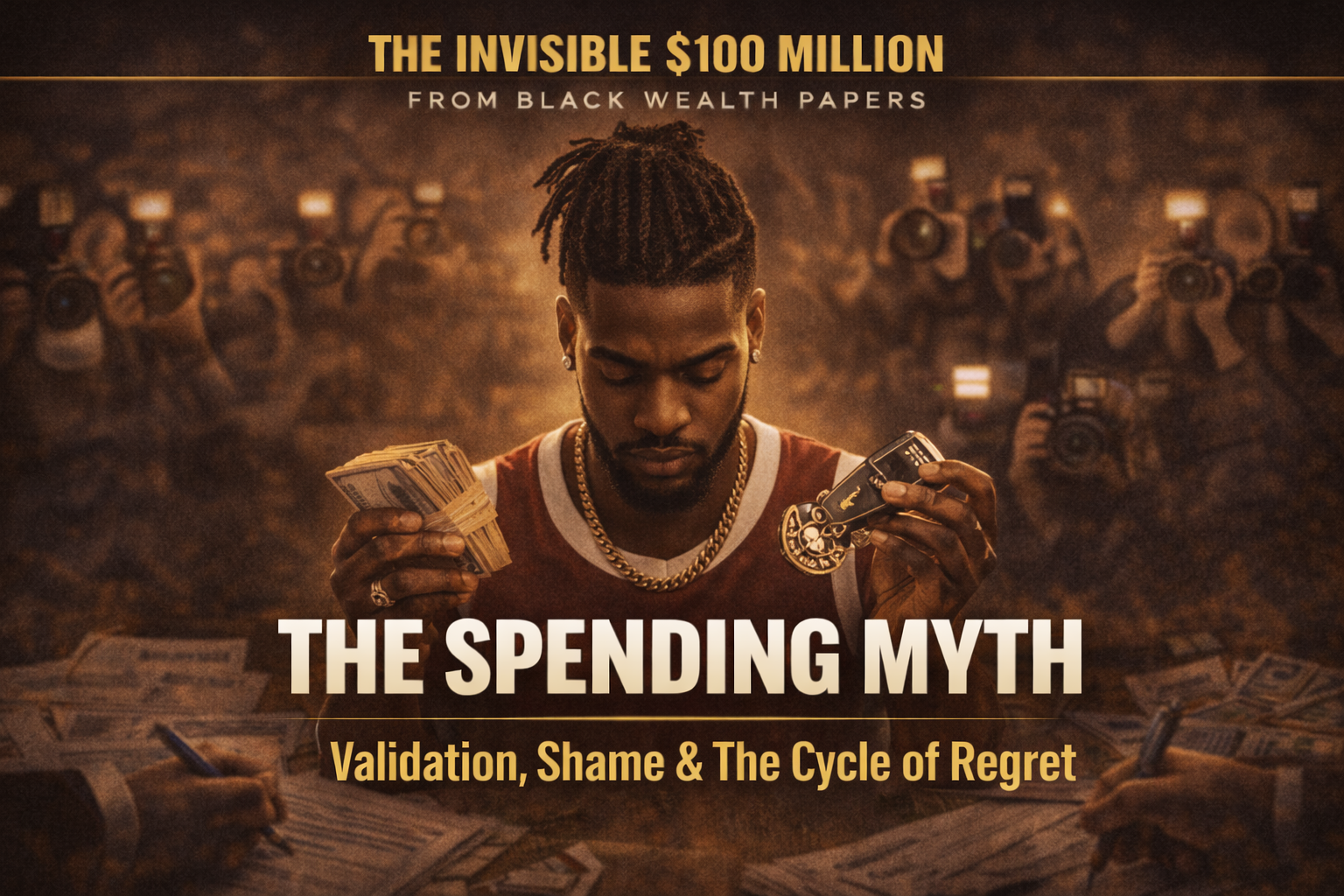

Part 5 of The Invisible $100 Million Series
From The Black Wealth Papers
The first bill does not come from an agent.
It does not come from taxes.
It does not come from advisors.
It comes from home.
What the Rescue Role Looks Like Up Close
When an athlete becomes the first to make it, the role is assigned quietly.
You made it out.
You can help.
You should help.
Not because anyone is malicious.
Because survival taught people to depend on the one who escaped.
Rent needs covering.
Cars need fixing.
Bills are behind.
Emergencies never stop coming.
The money feels shared before it ever feels owned.
Why This Pressure Is Invisible to Outsiders
Fans do not see this part.
They see luxury cars.
They see jewelry.
They see vacations.
They do not see:
- the late night phone calls
- the guilt attached to saying no
- the fear of being seen as selfish
- the unspoken rule that success belongs to everyone
This is not charity.
It is obligation.
And obligation compounds faster than money.
The Emotional Cost of Being First
First-generation wealth is not quiet.
It is loud.
It is watched.
It is judged.
Every purchase is interpreted.
Every boundary is questioned.
Every refusal is remembered.
The athlete is not just managing money.
He is managing relationships.
That pressure does not exist for executives whose families already had stability.
It does not exist for owners whose wealth had time to mature.
It exists here.
At athlete scale.
Helping Everyone Feels Like the Right Thing
At first, helping feels empowering.
You fix problems.
You stabilize households.
You become the answer people prayed for.
But the math never works.
Because the needs do not shrink when the income grows.
They expand.
And eventually a realization arrives.
Helping everyone is actually hurting your long term ability to help anyone.
That realization comes late.
Often too late.
Why Saying No Feels Like Betrayal
The system does not teach athletes how to set boundaries.
The culture does not reward restraint.
From childhood, the message was clear.
Your success is not yours alone.
Your gift belongs to the village.
So when the athlete tries to protect the future, it feels like abandonment.
Not just to others.
To himself.
The Part No One Prepares Him For
The career is short.
The responsibility is long.
When the income slows or stops, the expectations do not.
The same people who needed help before still need help after.
The same families still face the same pressures.
But now the athlete has less leverage and fewer options.
This is where shame enters.
Why This Is Not a Spending Problem
This is not about reckless choices.
It is about:
- timing
- obligation
- emotional pressure
- cultural responsibility
This is the Black tax at athlete scale.
It is not written into contracts.
It does not show up on spreadsheets.
But it drains wealth just as effectively.
The Bigger Truth
Athletes do not lose money because they are careless.
They lose money because they are asked to solve generational problems with individual income.
No amount of discipline can outwork that math.
Until the system acknowledges this pressure and builds structures that protect both family and future, the curve will keep repeating.
Quietly.
Predictably.
Painfully.
About the Author
Brian B. Turner is the author of The Black Wealth Papers, a cultural and financial book series examining how wealth, timing, systems, and history shape outcomes long before individual decisions are made.
His work focuses on first-generation earners, athletes, entrepreneurs, and builders navigating systems they were never taught to understand. Rather than blaming individuals, his writing exposes the structures behind money, ownership, and power, and offers clarity where shame is usually placed.
The Invisible $100 Million is the second book in The Black Wealth Papers series and a direct continuation of Why You Are Not Behind.
About the Book
The Invisible $100 Million explores why so many Black athletes and entertainers earn massive sums yet struggle to keep it, not because of recklessness, but because they collide with systems never designed for them to build ownership.
From youth sports pipelines and NIL deals to draft-day contracts, media narratives, and predatory financial ecosystems, the book reveals how wealth can disappear even when the income looks enormous.
This is not a scandal book.
It is a cultural and financial investigation.
📘 The Invisible $100 Million
👉 https://amzn.to/4jjIUKY