


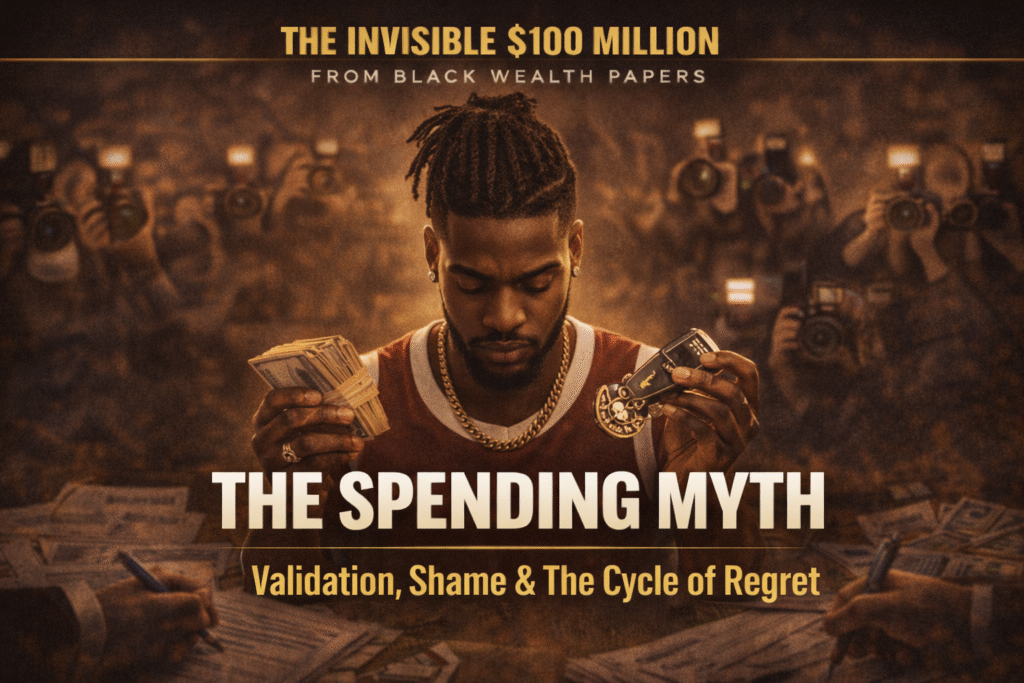
Part 8 of The Invisible $100 Million Series
From The Black Wealth Papers
People love to say athletes blow money.
Cars. Jewelry. Trips. Clothes. Parties.
The narrative is simple.
Too much money. Not enough discipline.
That story is convenient.
It is also incomplete.
Because most athletes are not spending to feel rich.
They are spending to feel safe.
The Lie About “Bad Spending”
From the outside, the purchases look reckless.
From the inside, they are emotional responses to pressure.
When you grow up without margin, money does not feel like freedom.
It feels like a clock.
You are racing the fear that it could disappear.
You are racing the expectations of people who watched you struggle.
You are racing the shame of finally having access and not knowing how to use it.
Spending becomes a way to prove arrival.
Not just to others, but to yourself.
Validation Is a Cost, Not a Luxury
Every purchase is witnessed.
The watch confirms success.
The car confirms progress.
The house confirms you made it out.
Validation becomes a form of protection.
If people see the lifestyle, they stop asking questions.
If they see wealth, they assume stability.
If they assume stability, they stop worrying about you.
Visibility becomes armor.
The problem is armor is expensive to maintain.
Shame Fuels the Cycle
Athletes are taught early to project confidence.
Weakness is punished.
Confusion is hidden.
When money starts slipping, silence replaces strategy.
No one wants to admit they are unsure.
No one wants to admit they feel behind.
No one wants to admit the lifestyle costs more than the income supports.
So spending continues.
Not out of greed.
Out of fear of being exposed.
The Cycle No One Names
Here is the loop no one talks about:
Earn fast.
Spend to validate.
Feel pressure.
Hide confusion.
Avoid asking for help.
Spend more to keep the image alive.
By the time the questions come, the money is already working against you.
This is not a character flaw.
It is a psychological response to sudden visibility without preparation.
The System Benefits From the Myth
As long as the public believes athletes fail because of spending, no one asks harder questions.
No one asks why financial education comes after contracts.
No one asks why ownership is rarely taught.
No one asks why wealth literacy is optional in billion-dollar industries.
Blame stays personal.
Systems stay protected.
The Truth Beneath the Purchases
Most athletes are not trying to look rich.
They are trying not to look lost.
They are trying to outrun the fear that this moment is temporary.
They are trying to justify the sacrifices that got them here.
They are trying to silence the voice that says, “What if this ends sooner than I think?”
Spending is not the problem.
The absence of structure is.
Why This Matters
Until we stop framing this as a spending issue, the cycle will repeat.
New faces.
Same headlines.
Same judgments.
We will keep laughing when athletes warn us.
And we will keep pretending we do not understand.
The money is not disappearing because athletes are careless.
It is disappearing because validation costs more than people admit.
And no one taught them how to build something that lasts longer than applause.
About the Author
Brian B. Turner is the author of The Black Wealth Papers, a cultural and financial book series examining how wealth, timing, systems, and history shape outcomes long before individual decisions are made.
His work focuses on first-generation earners, athletes, entrepreneurs, and builders navigating systems they were never taught to understand. Rather than blaming individuals, his writing exposes the structures behind money, ownership, and power, and offers clarity where shame is usually placed.
The Invisible $100 Million is the second book in The Black Wealth Papers series and a direct continuation of Why You Are Not Behind.
About the Book
The Invisible $100 Million explores why so many Black athletes and entertainers earn massive sums yet struggle to keep it, not because of recklessness, but because they collide with systems never designed for them to build ownership.
From youth sports pipelines and NIL deals to draft-day contracts, media narratives, and predatory financial ecosystems, the book reveals how wealth can disappear even when the income looks enormous.
This is not a scandal book.
It is a cultural and financial investigation.
📘 The Invisible $100 Million
👉 https://amzn.to/4jjIUKY